

This article is aimed at any advertiser trying to understand and improve the conversion attribution on its affiliate campaign. We will start by explaining what are the most used conversion attribution models. We will finish with some tools that will help you to master the management of your conversion attribution.
1- Definitions
Conversion attribution: Conversion attribution determines which marketing channels or touchpoints contribute to a desired action or conversion. This can include a purchase, sign-up, or download.
Touch points: Marketing touchpoints are interactions between a brand and its target audience throughout the customer journey. In affiliate marketing, we usually measure touchpoints as clicks generated by affiliates.
2- The most used conversion attribution model in affiliate marketing
The last click count attribution model is used in affiliate marketing. It attributes 100% of the credit for a conversion to the last affiliate link clicked by the customer.
This occurs before making a purchase or completing the desired action.
The benefits of the last click count attribution model:
- It is easy to set up technically.
- It helps affiliates forecast their earnings more accurately. This allows them to invest more in promoting the campaign.
- It provides enough data on touchpoints to optimise conversion attribution.
The drawback of the last click count attribution model:
- When conversion is not optimised, it mostly rewards lower-funnel affiliates.
3- Other attribution models
Besides last-click attribution, there are several other models. These include first-click and linear attribution.
The graphic below explains how these models work.
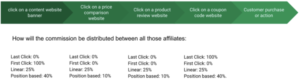
All those attribution models have drawbacks and benefits. You should choose the best model based on a deep understanding of each touchpoint in an already running affiliate campaign.
Custom attribution models
Some platforms or measuring/attribution software will recommend using their own ‘house-built’ attribution model. However, due to the lack of transparency in their workings and the often challenging optimisation of campaign attribution, we do not recommend their use. It can also scare potential affiliates to promote your campaign.
4- Tools to master the affiliate conversion
At Daisycon we offer tools to help you manage attribution for your affiliate campaigns. We also ensure that all your affiliates receive fair rewards for their efforts in promoting your campaign, while keeping the ROAS (Return On Advertising Spend) of your affiliate channel under control.
The conversion assist overview
The conversion assist overview gives you a global overview of all the touch points on your channel. Using it will permit you to see what is the contribution of each touch point on your campaign.
For example, sortering your touch points by the ‘Win’ percentage enables you to easily see which affiliate media do contribute a lot to your campaign. This happens even without always receiving a commission for it:
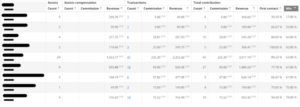
You can then decide to reward those publishers by for example raising the commission they will receive when a commission is attributed to them. By giving them an extra CPC commission or allowing them to use a dedicated promotion code that will attribute all transactions made with their promotion code to them even when another affiliate media is involved further down.
Read more about the conversion assist overview in this article.
The shopping cart pixel
One of the largest drawbacks of the last click count attribution model is that conversions are often attributed to promotion code publishers. This occurs when a consumer is looking for a discount at the last moment of his purchasing journey.
To keep this under control we give our advertiser the possibility to use the shopping cart pixel. This feature offers the advertiser the possibility to assign a (possible) transaction to a publisher, for the length of an agreed time. As soon as the visitor places a product in the on-line shopping cart. Even if the visitor (temporarily) leaves the website, the revenue won’t be rewarded to other publishers upon order fulfillment.
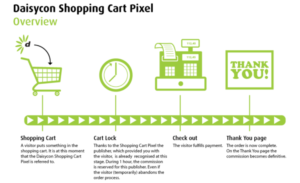
Read more about the shopping cart pixel.
Want to know more? Contact us now!

