
Ask ChatGPT, Gemini, Claude, or Perplexity for a product recommendation today, and it will name specific sources: comparison sites, reviews, specialist publishers, rather than simply listing links the way a search engine does. That answer is being generated right now, for real users, whether or not a brand has any idea what it says. Daisycon and Trendata built AI Publisher Discovery to answer a question most advertisers currently cannot: which publishers are shaping the AI-generated answers in our category, and are we already working with them?
Three challenges advertisers are running into
The answer isn’t something you can just check. Unlike a search results page, a conversational answer depends entirely on how a question is phrased, and it shifts as the underlying models and their sources update. Without a systematic way to sample this, most brands are relying on guesswork rather than a repeatable measure.
Being visible for a category doesn’t mean being visible for the question that matters. A brand named directly in a query usually appears in the answer about itself. A broad category question tends to surface a comparison. But as a question becomes more specific, a smaller, specialised publisher often becomes the source that gets cited instead, and a brand that dominates general category searches can quietly disappear from exactly these higher-intent, more specific ones.
Website analytics stop at the front door. The path to conversion has changed shape:
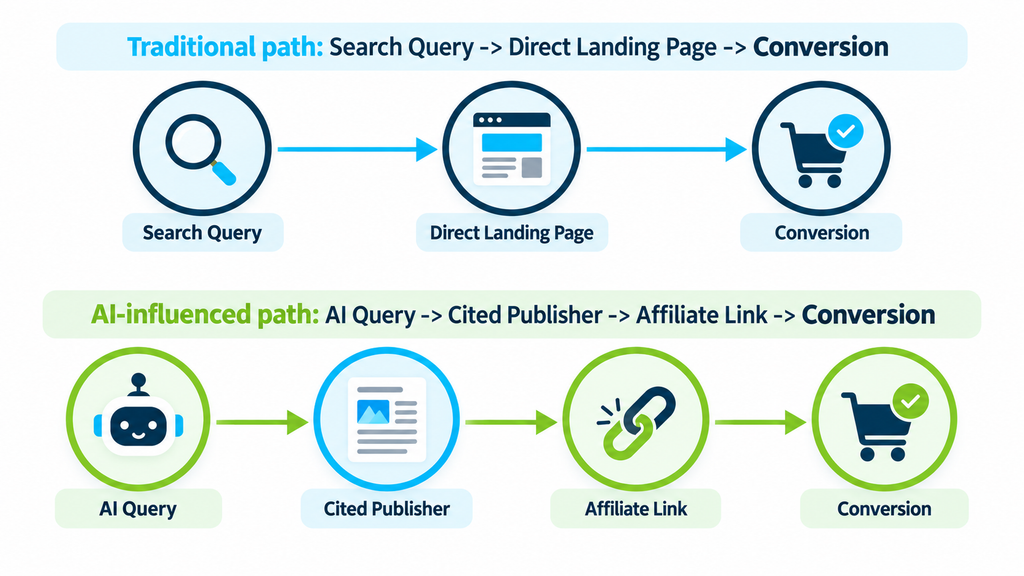
A brand that only measures what happens once a visitor lands on its own site has no visibility into the step that decided whether that visitor arrived at all.
Why this calls for demand intelligence, not test prompts
Addressing this is not a matter of typing a handful of manual prompts and noting which brands come up. That is a snapshot, not a system, and it goes stale as soon as query patterns shift. It takes continuous tracking of actual, measured orientation volume, not self-selected prompts, mapped to the publisher sources that AI systems are actually citing. Trendata’s Demand Intelligence platform does exactly that: it follows consumer questions across search, social, and AI, including ChatGPT, Gemini, Claude, and Perplexity, alongside Google and Bing, with data refreshed monthly and visibility spanning up to 48 months back and 12 months forward.
That produces a concrete benchmark, the Share of Answer: the share of measured demand volume within a category where a given brand’s publishers are the ones being cited. It can be tracked before activation and again afterward, to see whether anything has actually moved.
From insight to action
Daisycon takes that intelligence and turns it into affiliate recruitment. That means reviewing both the publishers already active in a category and the relevant sites that show up often in AI answers but are not yet part of the network, then approaching and activating the latter within a campaign. Trendata surfaces where the opportunity sits, Daisycon converts that into reach and commercial results.
Let’s be straightforward about what this approach delivers: a measured, repeatable baseline and a clear, concrete path to act on it.
The AI landscape is evolving, and current measurement tools have realistic limits. No one can accurately claim one-to-one attribution or guaranteed shifts in share of voice just yet. Instead of over-promising, we focus on what is genuinely valuable and actionable today: giving you clear, reliable visibility into your actual share of answer.
Where it works best
The strongest results tend to appear in categories where consumers actively compare options, particularly physical, comparable products, with queries like “best X for Y”, “which X suits me”, or “X versus Y” leading straight to a shortlist.
Why start now, with this pairing
The offering itself is new, but neither party is untested. Daisycon has spent more than 25 years building affiliate partnerships, and Trendata more than 8 years developing AI-driven market intelligence. Trendata’s forecasting is reported to hold up at over 85 percent accuracy against historical data, which is part of why the intelligence side of this can be trusted to inform real commercial decisions rather than just interesting reading.
That said, this is launching with a limited group of advertisers rather than a full rollout, deliberately, so the wider approach gets shaped by what actually happens in the market rather than by projection alone.
Want to discover, as one of the first advertisers, what role your brand plays in the AI orientation of your category? Leave your details here and be the first to know when we launch.

